A new buyer has arrived. They use AI before Google. They form a shortlist before they talk to anyone. They walk into the first sales conversation with a view already built — not by your campaigns, but by what AI surfaced before you knew they were looking.
Most B2B marketing teams are still optimizing for a world that no longer exists. This is the full playbook for what comes next.
94% of B2B buyers use AI for self-guided research before talking to anyone. The shortlist forms before your CRM knows they exist.
75% of AI's economic gains are captured by 20% of companies. The gap is architecture, not technology or budget.
The 9-phase playbook covers the full buyer journey — from pre-market synthetic testing to community-led advocacy — and answers what marketing teams look like when machines handle execution.
The Framework
The 9-Phase Playbook for the Agentic Era
One phase per week, starting Week 2. Every phase answers two questions: what does a marketing team actually look like when machines handle execution? And where is human judgment still worth more than a machine?
PHASE 0
The Case for Rewiring
Why the 2019 playbook is broken
Complete
PHASE 01
Pre-Market / Synthetic Persona Testing
Before the market knows you exist
Complete
PHASE 02
Awareness
Getting found by humans AND machines
Complete
PHASE 03
Website & AI
What AI sees when it reads your website
Complete
PHASE 04
Acquisition
Reaching buyers before they search
Week 5
PHASE 05
AI Nurture
The motion most teams are missing
Week 6
PHASE 06
Human-in-the-Loop Conversion
Where empathy still beats algorithms
Week 7
PHASE 07
Revenue Realization
Removing friction between contract and cash
Week 8
PHASE 08
Autonomous Onboarding
Time-to-value without hand-holding
Week 9
PHASE 09
Predictive Expansion
Growing accounts before they ask
Week 10
PHASE 10
Community-Led Advocacy
Making customers your most powerful channel
Week 11
Thread 1 — Org Re-Wiring
What the marketing team looks like as AI handles more execution. From 30-person teams to strategic leaders managing AI agent swarms. Channel ownership has already shifted. The org chart hasn't caught up.
Thread 2 — Human Authenticity
Where human judgment is still worth more than a machine. The creative frame. The strategic bet. The close. The community. At every inflection point in the buyer journey, this is where humans still decide the outcome.
Phase 0
The Case for Rewiring · Posts 1–4 · Week 1 (Apr 14–18, 2026)
Phase 0 · Week 1 · Apr 14–18, 2026
The Case for Rewiring
4 posts · Complete
Phase 0 · Week 1Post 4 of 60
The 9-Phase Playbook for the Agentic Era
Three posts made the case. Now comes the rebuild.
The B2B buyer journey used to have one path. Marketing owned the top. Sales owned the close. CS owned everything after the contract. That still exists. A second journey now runs alongside it — AI tools researching vendors, building shortlists, and in some cases completing purchases before a human ever gets involved. Some B2B buyers are starting to move between the two. When they cross over to the journey marketing did not build, they disappear.
For the next nine weeks, one phase per week, I walk the entire B2B customer journey — from before the market knows you exist to after the contract is signed.
Every phase answers two questions. What does a marketing team actually look like when machines handle the execution? And where is human judgment still worth more than a machine? The answer changes at every phase — that is the point. After the nine phases, two more weeks: the data foundation underneath all of it, and what the CMO of 2027 has to build.
This is not a series about AI marketing. It is a series about what marketing leadership requires now.
Nine phases. Starts Monday.
Phase 0 · Week 1Post 3 of 60
The gap is not technology. It is architecture.
75% of AI's economic gains are being captured by just 20% of companies. [PwC, April 2026] The gap is not technology. It is not budget. It is architecture.
And marketing is where it shows up first. 67% of B2B buyers now prefer to complete purchases without talking to a sales rep. [Gartner, March 2026] Twice as many buyers are naming GenAI as a more meaningful research source than any other channel. [Forrester, 2026] The buyer has already rewired how they find, evaluate, and decide.
The 20% capturing the gains are not running better campaigns. They are rebuilding the revenue motion — how buyers are finding them, how they are evaluating, how they are buying, how they are expanding. The whole system, not one stage of it.
The 80% are running the same play with better tools. New technology, old assumptions. A funnel designed for a buyer who researched on Google, responded to outreach, and talked to a rep before deciding. That buyer is gone. The funnel is still there.
What makes this hard is that patching is working — in the short term. Pipeline is still moving. The system feels fine right up until it doesn't.
The companies pulling away are not smarter. They are making a harder call earlier.
That is the rewiring. Not a tool. Not a campaign. A decision about whether you are building for the buyer who is already showing up — or still optimizing for the one who used to.
Phase 0 · Week 1Post 2 of 60
The shortlist is forming before your CRM knows they exist.
94% of B2B buyers use AI for self-guided research before they talk to anyone. [Forrester, 2026]
The shortlist is forming in ChatGPT, in Gemini, in Perplexity — before your campaigns, before your SDR, before your CRM knows they exist.
Most teams are optimizing for the moment after the buyer has already decided. That is the problem. The next 58 posts are about the fix.
Phase 0 · Week 1Post 1 of 60
The disruption is not coming. It is already happening.
B2B buyers are using AI before they open a browser tab. They form a shortlist before they talk to a sales rep. They walk into the first sales conversation with a view already built — not by your campaigns, but by what AI surfaced about you before you knew they were looking. The funnel assumes you control the entry point. You do not.
Most B2B marketing teams are still running the 2019 playbook. Gated content, SDR sequences, Google rankings, MQL targets. Not because the people are wrong — because the measurement systems, the budgets, and the org structures were all built for a buyer that has already moved on. The gap between how buying actually happens and how marketing is built has never been wider.
Over the next 12 weeks I am going to get into what it takes to close that gap. Not tweaks. Not tool adoption. A full rewiring of the motion — from how you build visibility, to how you measure influence, to how you structure the team. This is The Great Marketing Rewiring.
The evaluation is happening before your sales team knows it exists.
Phase 02 was about two readers. The AI deciding whether your content was worth surfacing, and the human deciding whether you were worth trusting. Thought leadership, contrarian POVs, and structured facts are what get you found.
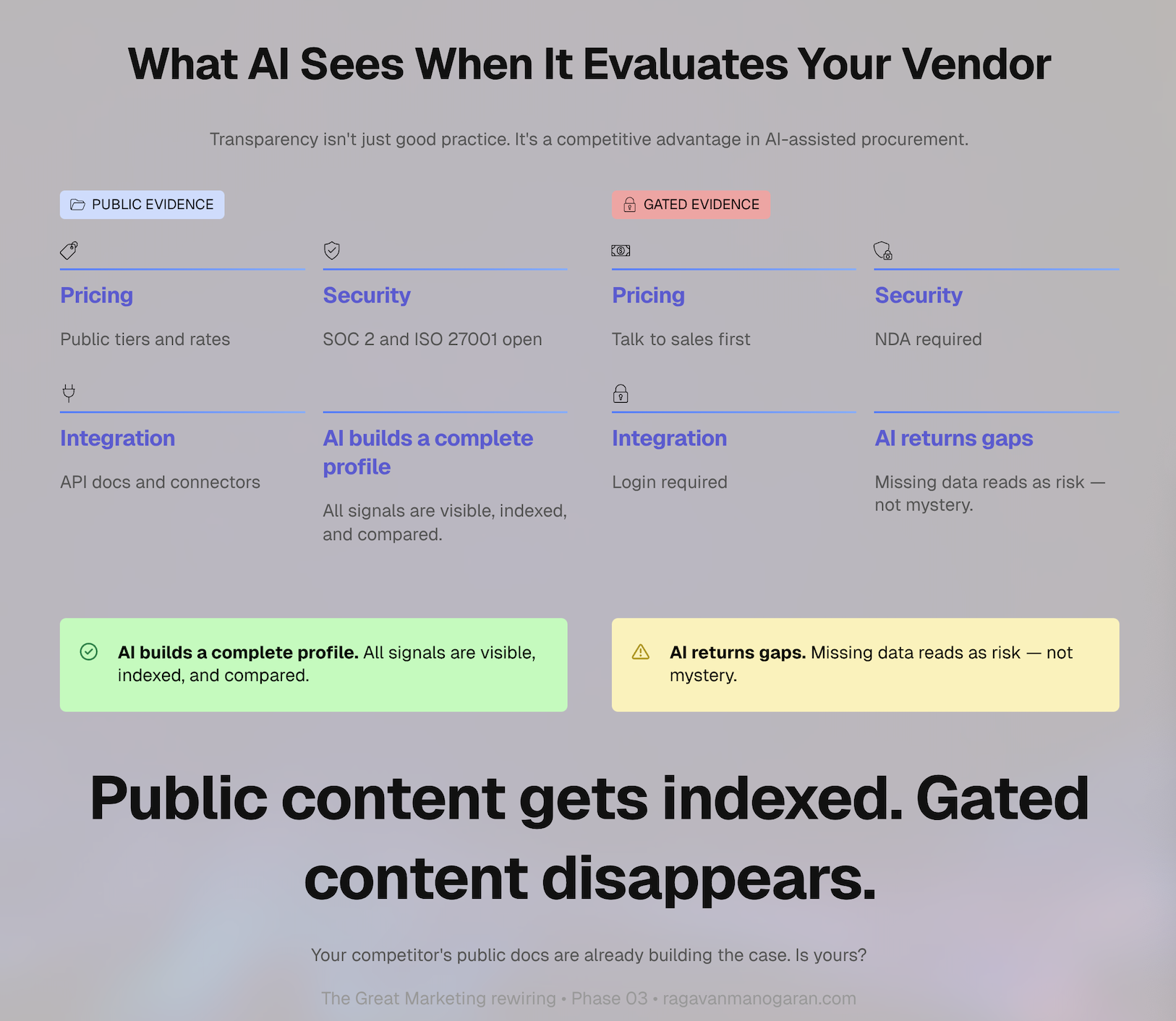
Phase 03 is a different question entirely. When AI switches from discovery to evaluation, it is no longer asking who is worth knowing about. It is asking whether you can actually do the job. That means pricing, security posture, compliance documentation, and integration specs are some of the information that needs to be AI accessible. Most B2B companies have this evaluation evidence. It just lives in sales decks and email threads that AI cannot read. You do not need to make all of it public. You need enough of it on the open web for AI to evaluate whether you belong on the shortlist.
51% of B2B software buyers now start their purchasing process in an AI chatbot, not a search engine (G2, 2026). 69% ended up choosing a different vendor than they originally planned, based on what the AI told them (G2, 2026). The evaluation is happening before your sales team knows it exists.
Phase 03 · Week 4Post 16 of 60
Your internal champion is not the only one researching you.
Your internal champion is building a case for you inside their company. At the same time, 10 other people in that same buying committee are researching you from a completely different angle. Most B2B deals now involve 11 or more stakeholders (6sense, 2026).
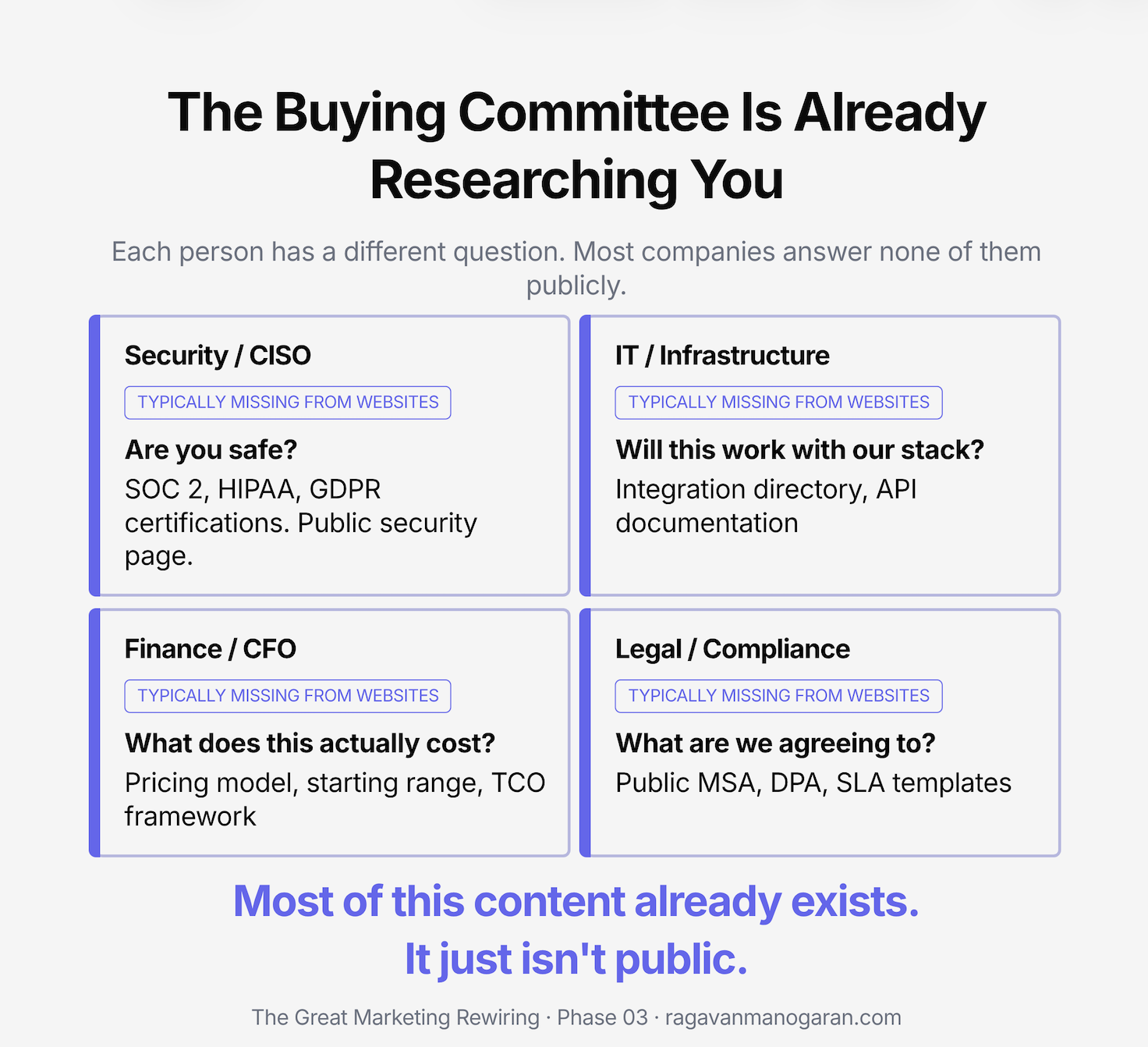
Your champion wants to know if your product solves the problem. The CISO wants to know if you are safe. The CFO wants to know what you actually cost over three years. Legal wants to know what happens if something goes wrong. They are not waiting for your champion to brief them. They are running their own AI search before that conversation ever happens.
66% of B2B tech buyers require a SOC 2 report before a deal moves forward (Uzado, 2026). 79% of purchases need explicit CFO or finance approval (TrustRadius, 2024). These are not late-stage checkboxes. They are day-one filters that most B2B companies never see coming.
Edelman and LinkedIn found that these hidden buyers carry just as much weight in the final decision as the person who will actually use your product (2025). If the answers are not on the open web, they are not asking your champion. They are forming a view on their own. And doubt at the committee level kills deals before your champion ever gets to present.
Phase 03 · Week 4Post 17 of 60
The gap in the AI summary is not neutral. It reads as risk.
Most B2B companies gate their best evidence for a reason. Pricing requires context. Security documentation is sensitive. Integration details depend on the tech stack. That logic made sense when a buyer called a sales rep to get the answers.
The problem is that 42% of procurement leaders now use AI to generate vendor comparisons before a rep is ever involved (Deloitte, 2025). AI works with what it can find publicly. A gated pricing page returns no price. An NDA-walled security report returns no security posture. A login-required integration doc returns no integrations. The buyer's AI summary has gaps where your profile should be.
A gap is not neutral. In an AI-generated vendor comparison, a gap reads as risk. The first companies to make their evaluation evidence public will show up more completely than anyone else in their category. That advantage gets larger every time a buyer runs a comparison.
Phase 03 · Week 4Post 18 of 60
Most companies already have the answers. They just are not public.
Most companies already have the answers to every question the buying committee is searching for. They live in sales decks, security questionnaires, legal templates, and customer stories. None of it is public yet.
Each member of the buying committee is searching for something different. The CISO wants certifications, not the full audit report. Finance wants the pricing model, not the custom quote. Legal wants the DPA and MSA available before the first sales call, not sent over email after a demo. The infographic maps what each buyer needs.
Phase 03 · Week 4Post 19 of 60
Putting your procurement evidence on your website is not a transparency play. It is a category move.
Phase 03 was about one thing: the evaluation happens before your sales team knows the customer is doing their due diligence. An AI agent builds the vendor comparison. Each member of the buying committee runs their own search. The companies with public certifications, pricing signals, and legal templates on their website make the shortlist. The ones with gaps do not.
Here is my call. Putting your procurement evidence on your website is not a transparency play. It is a category move. The first company to do it completely does not just show up in more AI comparisons. It becomes the benchmark every other vendor is measured against.
Phase 02 and Phase 03 were both about what happens when a buyer comes looking. Organic content that survives two readers. Procurement evidence that survives the AI shortlist. Next week is the other direction. AI is also changing how you target buyers who are not looking for you yet. Paid media, email, outbound, and ABM. That is Phase 04. Next week.
Phase 02 was about one thing: awareness content now has two readers. The AI deciding whether your content is worth surfacing. The human buying committee deciding whether your offering is worth trusting. The two-layer architecture is how you serve both.
Here is the call I will make. AI can synthesize everything the category believes faster than any team can write it. A B2B buyer researching your category already has that summary. To stand out, either you are the source AI is citing or you are different enough that AI cannot reduce you to a bullet point.
In Phase 03, the B2B buyer is not involved in the research. An AI agent researches the category for them, picks the shortlist, and hands them a brief. By the time a human looks at the results, the evaluation is already done. That is Phase 03. Next week.
Phase 02 · Week 3Post 13 of 60
The org is the obstacle.
My last two posts were about what B2B awareness content needs to do in 2026. Build one layer for AI retrieval. Build another for the human buyer who is not yet shopping. Simple enough in theory. This one is about why most teams cannot get there even when they understand it.
The problem is structural. In most B2B marketing orgs, brand and demand operate separately. Brand owns narrative that is emotional, story-driven, built to resonate with a human reader in mind. While Demand owns facts that are structured, proven, and generally gated behind a form so the sales team gets a lead.
AI retrieval needs something neither team produces by default. Structured, factual content that is also public and ungated. Facts with a point of view. Neither a whitepaper behind a form nor a brand story that reads beautifully and answers nothing specific will work. Something in between that most org charts do not have a home for.
Only 22% of B2B marketing leaders say brand and demand are fully integrated in their organization (Forrester). That number is from 2020, and there is no strong evidence it has meaningfully improved. If anything, the pressure to show short-term pipeline in the last few years has pushed the two further apart.
The fix is not a reorg. It is a third lane of content. Brand and demand sitting down around the same content brief where Brand frames it and Demand grounds it in evidence.
Phase 02 · Week 3Post 12 of 60
Two layers. Most teams build one.
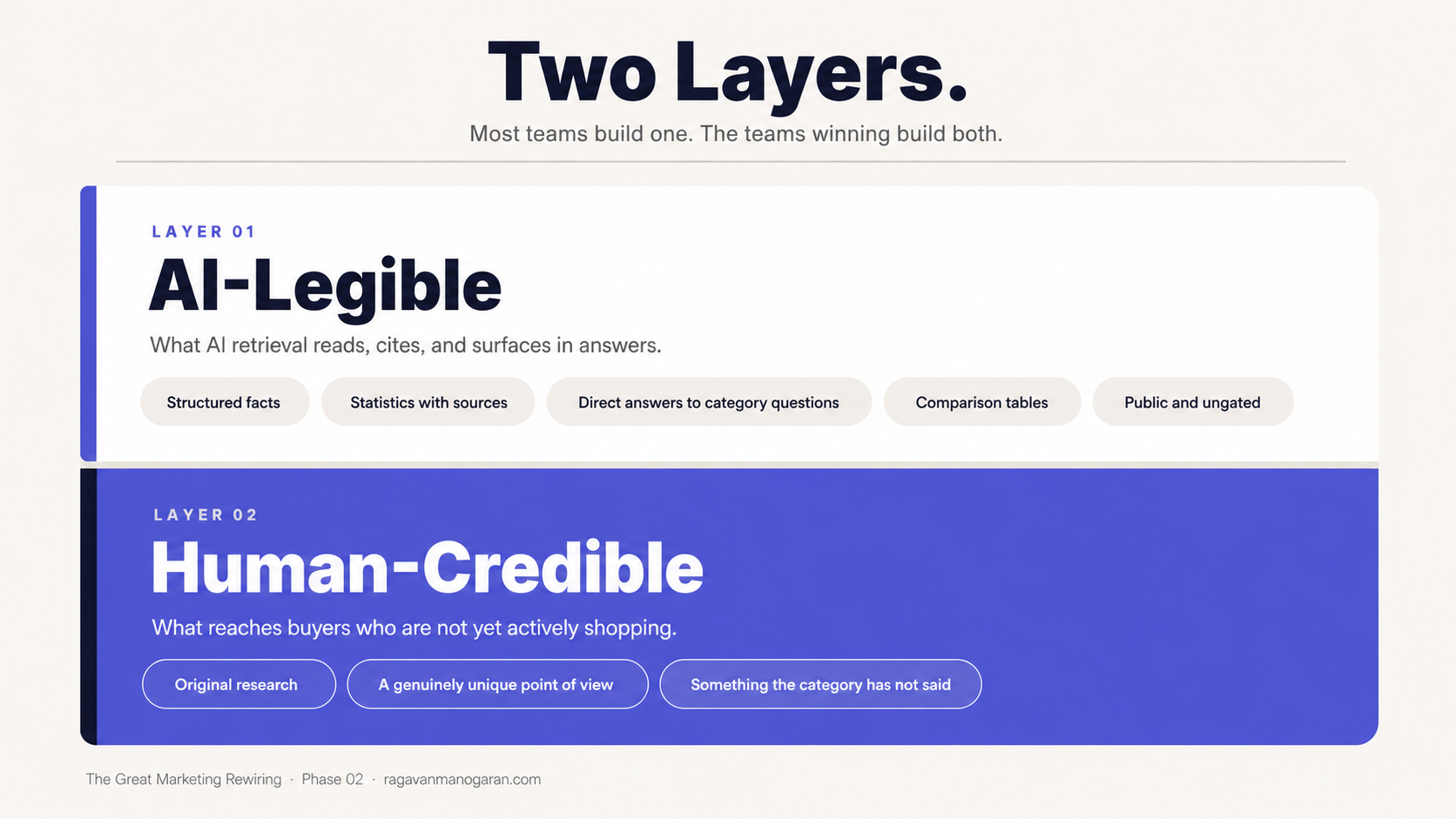
Post 11 was about two failures. This one is about the fix. The teams getting awareness right build content in two layers.
The first layer is AI-legible. Structured facts. Statistics with sources. Direct answers to category questions. Comparison tables that help buyers evaluate their options. Public and ungated. This is what AI reads and cites. It does not need to be compelling. It needs to be findable and factual.
The second layer is human-credible. Original research or a genuinely unique point of view that adds something the category has not said before. This is what reaches buyers who are not yet actively shopping, who are the majority of your B2B potential buyers at any given time. 75% of out-of-market B2B buyers say they researched a product they were not considering because of a piece of thought leadership (Edelman-LinkedIn, 2025).
Here is why originality matters more now than it ever has. AI-generated content is becoming more common. The only way for B2B brands to stand out in that environment is to publish something AI cannot originate. Not because AI lacks intelligence but because it has no lived experience, no unpublished data, and no stake in the outcome. Human judgment is what originates new ideas. AI can only follow (for now).
Most teams produce neither layer. They write narrative content that AI ignores and well, humans forget.
Phase 02 · Week 3Post 11 of 60
Two failures. One blind spot.
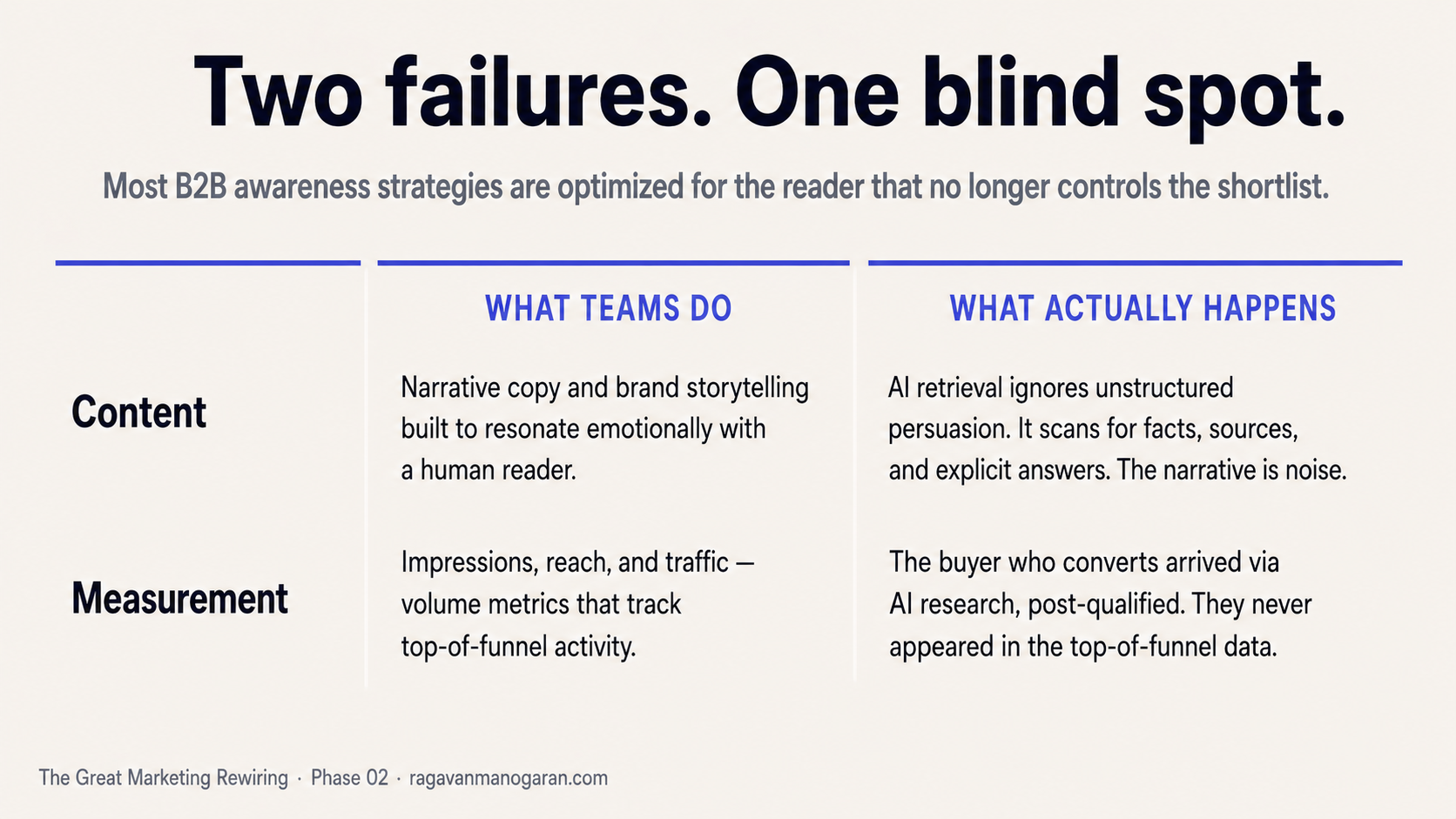
Most B2B awareness content is built to persuade a human scrolling a feed — narrative copy, brand storytelling, a point of view that resonates emotionally. That content fails the machine reader entirely. AI retrieval does not respond to unstructured persuasion. It scans for facts, sources, and explicit answers. The content built to win human attention is precisely the content AI cannot parse and will not cite.
That is the content failure. The measurement failure compounds it. Most teams track impressions, reach, and traffic — volume metrics built for a world where the top of the funnel was the entry point. The buyer who actually converts has already bypassed that funnel. They arrived via AI research, post-qualified, with the vendor shortlist largely formed. The metrics do not capture where the decision happened.
Both failures reinforce each other. Teams optimize for the metrics they can see. The buyer who converted via AI research never showed up in the top-of-funnel data. So the content strategy never gets challenged.
Phase 02 · Week 3Post 10 of 60
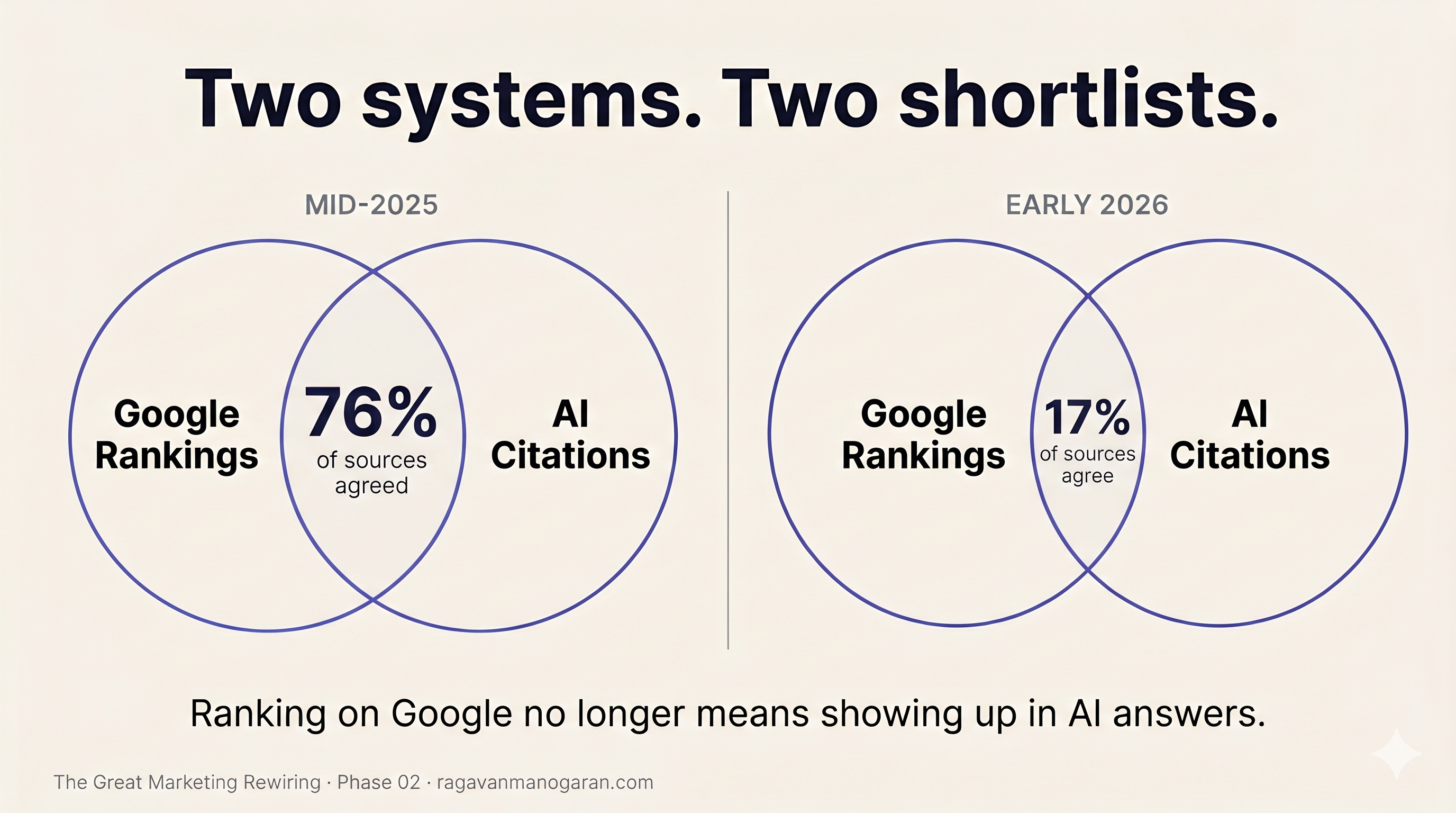
Two systems. Two shortlists.
94% of B2B buyers now use AI somewhere in their buying process (Forrester, 2026). Most are using it before they visit a vendor website, before they talk to sales, and increasingly before they have decided which category they are shopping in.
That creates two readers for the same piece of awareness content. The first is the human buyer — responding to voice, point of view, the sense that the author understands their problem. The second is the AI system summarizing the category by scanning for facts, sources, and direct answers to specific questions. Narrative does not move AI as much as facts, sources, and direct answers do. AI either finds the signal it needs or it moves on.
Most B2B awareness strategies were built for one reader. The content formats, the measurement frameworks, the editorial calendar are all optimized for the human. That is not wrong. It is incomplete.
This week is about what it takes to build for both.
Pre-market research has no feedback signal. That is why the errors compound.
Pre-market is the one phase where errors are impossible to measure in real time. There is no declining CTR, no slowed pipeline, no churn signal. The research gets done. The readout gets presented. The org proceeds as planned. By the time the wrong buyer model shows up in pipeline, it has already shaped your messaging, your targeting, and your content. Awareness targeted the wrong buyer. Content framed the wrong problem. Sales entered the wrong buying committee. None of those phases can fully correct what pre-market got wrong.
What makes this harder now is that AI is learning from the same errors. Your digital footprint is evidence. AI systems use it to infer who you serve, what problem you solve, what category you belong in. Get pre-market wrong and you are not just targeting the wrong buyer in your campaigns. You are teaching the machines to do it at scale, before your team has opened a single spreadsheet. A campaign can be paused. A market model can quietly become infrastructure.
The fix is not more research. It is a different architecture for what happens after the research is done. Most teams end pre-market with a readout — a presentation that lands, gets discussed, and gets filed. The org proceeds largely as planned. The teams closing the gap end pre-market with a running loop that feeds directly into how Awareness is built, what gets published, and who gets targeted. The model updates. The errors stop compounding.
Next week: Phase 02. In 2026, evidence is read twice — once by the buyer, once by the machines shaping what the buyer sees. Most teams are still building for one reader.
Phase 01 · Week 2Post 8 of 60
Nobody is measured on whether the pre-market insight changed a decision.
AI has made pre-market research faster and cheaper than ever. A team can have 50 validated insights from simulated buyers by Tuesday morning. And by Friday, most of those insights will have had no measurable impact on a single decision about pricing, positioning, or ICP. The speed of the research has increased. The accountability for acting on it has not.
The companies capturing the gains are not the ones with the best tools. They are the ones that rewired who owns the loop between insight and decision. Research does not live in a deck that gets presented once. It lives in a closed feedback loop — updated weekly from sales calls, competitive signals, and behavioral data — with explicit accountability for who changes what when the market tells you something new.
AI has made research fast and cheap. The architecture has not caught up. That is the gap.
Phase 01 · Week 2Post 7 of 60
The goal is not more feedback. It is better calibration.
The B2B marketing teams getting pre-market right have figured out something most have not — the goal is not more feedback. It is better calibration. And calibration requires a specific sequence.
Synthetic research runs first. By stress-testing hundreds of messaging, positioning, and pricing variants against simulated buyer profiles, you identify the specific segment with the sharpest problem signal — not the widest interest, but the most acute need. That narrows your ICP from "anyone who might have this problem" to a precise profile worth pursuing.
That precision changes the access problem entirely. Getting "a senior B2B buyer" in the room is vague — and vague asks get ignored. Getting a specific profile in the room is a targeting problem, and targeting is solvable. When you know exactly who you need, your outreach stops being a research invitation and becomes a peer-level intelligence exchange: here is what we found across your segment — does this match what you are seeing? The outreach that works with senior buyers is specific and peer-anchored — not a broad invitation to give feedback.
Then you have the real conversation — with buyers who have actual budget authority and real switching costs. That conversation validates what synthetic cannot: whether the problem is urgent enough to survive internal approval, whether willingness to pay holds at the moment of real commitment.
You then feed what you learned back into the model. The ICP tightens. The next round is more accurate than the last. Each iteration, you are getting closer to the buyer who will actually pay.
Synthetic narrows. Real buyers validate. The model updates. That is the loop.
Phase 01 · Week 2Post 6 of 60
The people giving you feedback before launch are almost never the people who will actually pay.
B2B pre-market research has a problem that rarely gets named. It is not the research method. It is who you are researching.
The people who show up to your advisory board are not representative of the market. They are the enthusiasts — the early adopters, the vocal advocates, the buyers with enough time and interest to participate. They will give you detailed feedback, strong opinions, and genuine excitement. But they are not the ones who will actually pay.
The buyers who will actually pay are often silent in pre-market. They are too busy. They do not join advisory panels. They evaluate quietly and decide fast. Your research almost never reaches them. And so your positioning, your pricing, and your messaging get built around the wrong buyer.
AI is making this worse before it makes it better. Synthetic tools make it easier than ever to generate feedback at volume — a thousand simulated responses in an hour. The problem is that volume is not validity. If the training data behind your synthetic personas skews toward the vocal and engaged, the output will too. Even when synthetic personas are built from real customer call transcripts (which is better), they still only model the buyers who engaged with you. The ones who evaluated quietly and moved on left no signal at all. You get more signal from the wrong source, faster.
Two behaviors drive this gap in B2B specifically:
— Loss Aversion: At the moment of decision, fear of leaving a known vendor outweighs the appeal of something better — even when the numbers clearly favor switching.
— Interview Effect: Enterprise buyers perform rationality when they know they are being observed. What they tell you in a survey or interview is the decision they think they should make — not the one they will.
CB Insights analyzed 431 failed VC-backed companies. 43% cited poor product-market fit as the primary cause — not poor execution, not bad timing. The market was misread before the first marketing dollar was spent.
The most dangerous moment in B2B pre-market is not when you have no data. It is when you have data that feels right and is pointing you in the wrong direction.
Tomorrow — what the teams getting this right actually do.
Phase 01 · Week 2Post 5 of 60
Two methods now exist for pre-market research. Most teams are only using one.
Something is changing in the market research space over the last two years. Not an incremental shift. A structural one.
For decades, the way B2B marketers validated a market before entering it was the same. Get real buyers in a real or virtual room. Run pilots. Conduct interviews. Build advisory boards. That method still works and is irreplaceable in certain moments.
But AI has created a second method. Synthetic personas — digital simulations of your buyer, built from behavioral data, CRM records, and call transcripts — can now stress-test hundreds of messaging variants, pricing models, and value propositions before a single human is involved. What used to take months and significant budget now takes hours. Stanford-led research with Google DeepMind tested 1,052 generative agents against real human survey data.
The synthetic models replicated survey responses with 85% accuracy and personality profiles with 80% accuracy.
That sounds definitive. It is not. Nielsen Norman Group evaluated synthetic users against real humans and found they "feel like a flat approximation of the experiences of tens of thousands of people, because they are." B2B research compounds this further — synthetic buyers may have little to no information on budget constraints, internal politics, and loss aversion at the moment of decision. The gaps that matter most in enterprise buying are exactly the ones AI cannot simulate. Both assessments are correct. They are describing different things.
Here is what the B2B marketing teams getting this right understand — these are not competing methods. They are different instruments built for different jobs. The mistake is not choosing the wrong one. The mistake is not knowing what each one can and cannot tell you.
This week is Phase I of the 9-phase B2B marketing playbook. Pre-market. The phase where revenue is won or lost before a single campaign fires.